


PC Month 3: June 2026

I left off the last newsletter one month ago sobbing as I took in what would be my new
surroundings for the next two years. Alas, as my favorite author likes to say, even fatigue and loneliness proved water soluble. I cried myself out, fell asleep, and thus made it through my first day at site.
The second day dawned and I decided to walk the length of the community, which took me 40 minutes round trip. Hualhuas is definitely small, we don’t have a single bank, grocery store, or even a postal code.
On the third day I climbed to the top of the nearest hill, pictured above. I nearly perished reaching the top, stopping every 25 steps to pant from the altitude. It was a stunningly clear day and I could see miles of the Montara valley and the river all the way to Huancayo. I relished being alone and outside. I was charged by four dogs on the way down and even though I had a rock to throw, I opted instead to speak amicably to them and was met with eventual success. I think it was my English that startled them more than anything.
On the fourth day, the presidential election, which the Peace Corps had so feared, passed completely nonviolently, though the results are extremely close. On June 10th, it was Fujimori at 50.002% and Sanchez at 49.998%, with less than a 600 vote disparity.

Minus the dog, Abby, and a random axolotl that lives in a bucket in the bathroom, there are 7 of us in the home. First is my host mamita, Juana , who is certainly a force to be reckoned with. Then there’s Juana’s three children, Robert (18, studying international business at the local university and working in an oatmeal factory), Miguel (“Migi”, 32, farmer), Eulalia (“Lala”, 37, works night shifts at a bank in a nearby city), and Lala’s two children, Mafer (5, my closest friend here, absolute menace before 10 am but otherwise lovely), and Nahum (11, we watch the World Cup together).
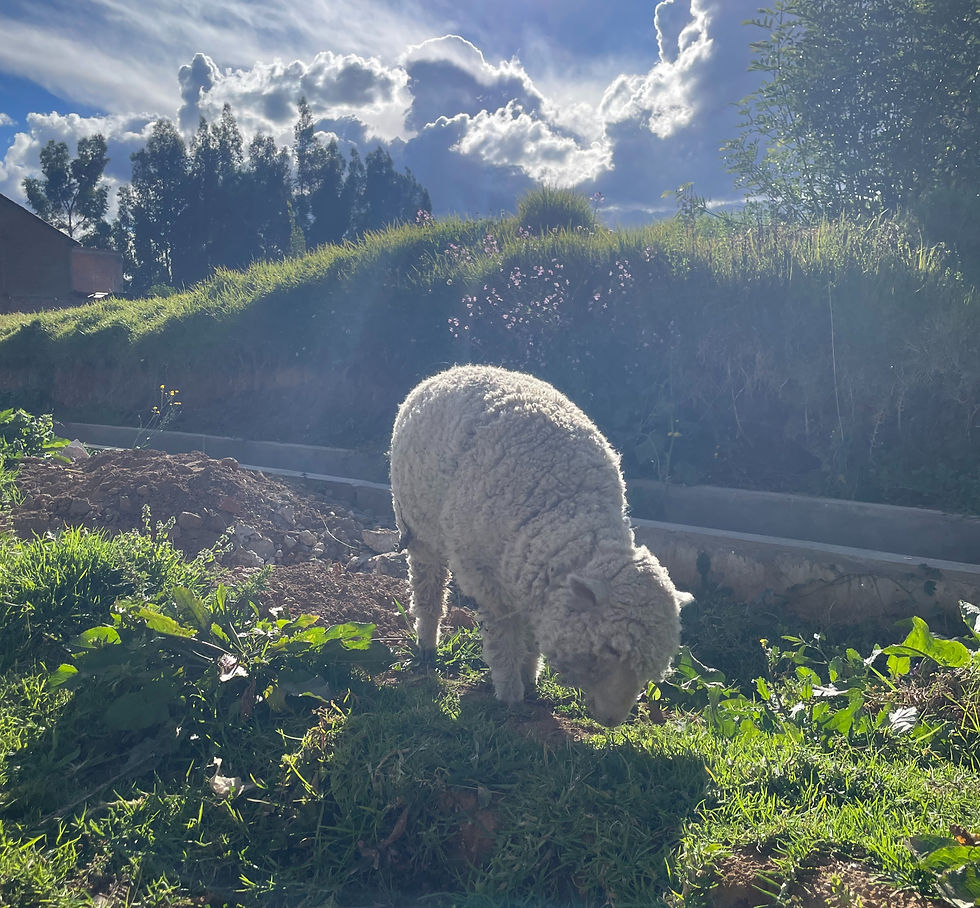
We do not have an address. Genuinely the only way to reach my house is either word of mouth or GPS coordinates. Our chacra is down the street and houses Juana’s dad, about a dozen hens with chicks, 10 piglets, over 100 cuy, 6 sheep, and two calves about 6 months old. The walls are made of metal sheeting and the roof is intermittent wood
planks. This is where they cook most of our meals on an open fire.
The first week with mamita Juana was intense. Retrospectively, I think she was asserting dominance - setting a series of strict rules and only feeding me rice and potatoes. Nutrient deficiency, which I am so privileged to be completely

unaccustomed to, hit me hard. My response to every situation she presented was compliance. I completely submitted to her ‘my house, my rules’ motif. This softened her significantly and I’m continuing to learn to recognize the ways she expresses affection. Genuinely, I consider us close in our own unique bond. Once, she took the bus all the way to Huancayo with me just to make sure I didn’t get lost on my way to a school I had never been to before. She trusts me to pick up her granddaughter from inicial by myself, 20 minutes each way on the bus. As I am learning, acts of trust are often acts of love. Another day, the whole family invited me along to have a picnic by her husband’s grave. Acts of inclusion are also acts of love.
This life requires the relinquishment of a lot of my independence, which is an adjustment coming
from the US. In fact, I’ve shed nearly every part of my identity upon stepping into this new life. Gone is
the person who is a captain, who does handstands, who hosts events, who is a crucial part of a tight-knit
community. I don’t even have a language with which to accurately express myself. Going from San Diego,
California to Hualhuas, Perú is akin to, to quote my therapist, feast to famine. I have been stripped down

completely. Nothing is familiar, nothing is comfortable, nothing is mine. I have led an unbelievably
saturated life for the past 10 years and now have found that my
busy-ness has come to a jarring halt.
There are benefits to this. When you’re not overstimulated,
little things become a big deal. Instead of living a lifetime in a
day, my days are marked by things like a pretty cloud, talking to a stranger, or getting a new sticker in my World Cup sticker book. Perú doesn’t bombard me at all times by temptation: sugar, ads, commitments, to-do lists. California was a feast for the senses. Privilege. Indulgence. Convenience. I have none of that here. Perú is my detox.
Here are some parts of my daily life that would surprise Madeline 3 months ago:
➔ The water situation: we have limited water at certain hours of the day. There is no hot water, so
mamita Juana will heat up a kettle and put it in a bucket for me once a week when I want to wash.
Since my last newsletter, I have taken a total of 4 “showers”.
➔ Guinea pig is a regular staple of my diet. They eat all the organs (even the brain).
➔ The cost of living is very cheap. I live on US $4.50 per day. I can get a fat soft serve ice cream cone
for less than 50 cents. Peace Corps pays a little more than $70 a month in rent and $6 a day for
three meals. Our June electricity bill was $3.32. An uber one hour to the nearest city is about $7.
➔ IT IS SO COLD ALL THE TIME
➔ The way that modern technology has found rural Perú continues to surprise me. I cannot
accurately describe the juxtaposition of seeing a real life shepherd in a field of sheep, holding a
freaking sheep hook, while scrolling on Tik Tok . It’s the craziest thing.

➔ Being an outsider is like having a backstage pass to any situation. I find myself in all sorts of meetings. I marched next to the mayor in a flag parade, sat in on a hearing for families appealing to the water committee for a larger ration, attended the mototaxi drivers union meeting with the municipality, and spoke at a workshop on ethical cuy raising by the social development office. I have no idea what will be in store for me on any given day.
➔ The World Cup has been the center of my life. It is an incredibly valuable resource to connect with my family, integrate with community members, fill awkward silences, and speak confidently. I’ve watched almost every game.
My first month centered around developing a routine. The current staple in this routine is the local volleyball league. I was placed with a team of 13 to 15-year-olds; I’m twice as old as them, twice as tall, and twice as bad. The first practice they didn’t pay me any mind. The second they stared relentlessly. This is one of the many situations where I’m glad I joined the Peace Corps at 28 rather than right out of college. Despite the fact that I stand out in every possible way, from my clothes to my height to my broken Spanish, I don’t feel compelled to shrink myself into inconspicuousness that I might have felt in my early twenties. When I catch people staring, which happens every day, I usually wave. I try to give them a look that conveys, “I know it’s weird that I’m here. You have no idea what I’m doing here, and many days, I don’t either”.

By the third practice the volleyball girls started to greet me by name. They began to realize that my appearance wasn’t a one-off, but I would be sticking around. One month later, I haven’t missed a single practice. I’m not improving very quickly, mostly because I’m being coached entirely in Spanish and I don't know what the coach is saying most of the time. Despite this, I’m a beloved member of the team.
So what do I do every day? Well, other than volleyball…I walk around a lot. I’ve been trying to acclimate to the altitude by doing yoga, but I’m still panting in downward dog. I spend an hour a day
formally studying Spanish. I eat all my meals with the family.

In the afternoons, I spend time with Mafer. It is

incredible how different an iPad-free child is. She sits
quietly and does a single activity with me for hours.
So far we’ve painted rocks, made a butterfly using
flower petals we found in the neighborhood, played in
the park, and gone to her annual school parade together.
Most of the day is spent with me, myself, and my emotions. Thank goodness I like being alone. As you’d suspect, I’m drawing, reading, and writing like crazy. New feelings surface often. I think about how doing Peace Corps, which is supposed to be one of the hardest things I’ll ever do, comes with free healthcare, not having to work a job, and someone cooking three meals a day for me. It’s as rough a life as I’ll probably ever know, yet many people in the world, including the people in my community, would trade places with me in a second. Even my version of hardship is many people's dream of success. It’s uncomfortable to sit with.
I cannot overstate how hard it is to live fully immersed in another language without reprieve, even with nearly every luxury given to me. I often think about how hard it must be for immigrants, for all the people surrounded by foreign language and no support system, and on top of that often actively shunned by our society. I have newfound respect for anyone who overcomes such odds. It makes me shudder to imagine trying to learn Spanish with an added fear of being deported and, in America, the additional threat of being shot and killed by government agents whether you are right or wrong. This perspective changes me every day.

On Monday’s I help out at the local soup kitchen, of which Juana is the President. The first week I wasn’t allowed to touch anything, but on the second I revealed that I subscribed to the World Cup, which made my usefulness more apparent. That week I was allowed
to wash dishes. By the third, I was up to serving drinks. Just like my volleyball team, I have to prove that I’m going to keep showing up before people are willing to invest in me and I’m okay with that. I can be consistent. Practicing embodying trustworthiness will serve me well in my life.
Integrating into the colegio was a…challenge that I won’t get into with how long this newsletter already is. I am currently not teaching any classes. However, I did go to the school’s annual dance competition. Sometimes the best way to describe my life here is a fever dream. This event was yet another fever dream for me. Every single student in the school competed, as well as students from nearby schools. The costumes were crazy, with each class dressed as the story they were telling, from birds to maidens to fishermen to alpaca. In fact, one class came onstage wearing real, very heavy looking, alpaca skins. In typical Peruvian fashion, there were stray dogs everywhere, including on stage, and one of the dogs ran away with a chunk of one of the students' costumes. I was doing everything I could not to burst out laughing. In the next dance they brought out a real alpaca, which clearly was not dress-rehearsed, because the poor thing kept spooking at the sudden movements and loud sounds and bucking like crazy while a stressed twelve year old desperately held on to the lead with

both hands. It lasted for hours, with each dance escalating the props and special effects of the last. There was a food fight complete with rotten fruit that made a huge mess. I couldn’t believe it.
I had to make a conscious effort to suspend my perception of the disjointed ridiculousness of it all to see that this is culture and it is a living thing. It is impressive to celebrate so passionately such a vibrant and active history. Each dance is telling a complex story that I don’t have the context to understand, but I can respect. Their ancestors likely did these same dances and wore similar costumes. This is who they come from, and it is not a dying flame. Peruvian cultural history is here in color and sound and the gathering of community and rotten fruit and the smell of animals and I am here for it.

In terms of actual work in my sector, Community Economic Development, I’ve been teaching an English class at the CEBA, an education program for adults who never finished elementary school. They can’t read or write, so progress is VERY slow. I get frustrated easily, but the teacher is so patient and calm and speaks incredibly simply to them without sounding superior. I respect his dedication to their cause.

Like in PST, my saving grace is the other volunteers. I am so very lucky that the other Junín PCV’s are a close knit and socially active group. One weekend we met
up in Jauja, Sadie’s site, and they showed me a
spot to hang hammocks above a lake that is full of wild flamingos, where we spent the whole day.
Another day, we all traveled to Tarma, Serena’s site, for another volunteer’s (Jude) birthday. Tarma comes out of nowhere, a city at the bottom of a deep valley. I had no idea how much I needed quality time with my cohort, but spending the weekend with Serena, Natalia, and Tylah absolutely healed me. There’s a video that I’ll link here that sums up the contradiction of Peace Corps

service. I wish I wanted to stay at my site all the time, integrate into the community, and become fluent in Spanish, but the reality is I need these reunions, with comfortable food, company, and language, to feel like myself again.
There have been a lot of fiascos, of course, like the time I took a shit at the office of the municipal water committee, only to find out that like a COMPLETE rookie I had not brought any toilet paper, there was no water in the sink, and the toilet didn’t have any water to flush. I don’t even want to say how I solved that situation, but let’s just say the next person to walk in there was likely not a happy camper.

It certainly wasn’t on my Peace Corps bingo card to chew coca leaves for the first time at a funeral. One of the family walked around the reception handing out the deceased’s “favorite things”, which were coca, whiskey, and cigarettes. I declined the latter two, but took a handful of the leaves. They were disgusting. You’re not supposed to swallow them, but it's hard not to with the way they break down and get in your teeth and the taste is awful. I can’t say that it did anything for me (though that might have been partially
due to the fact that I was too freezing cold to even feel my own blood).
Overall, Hualhuas is a great match for me. Like a wise woman I know (Audrey Fulk) says, there’s two kinds of hard - one is helpful, and one is harmful. Being here is difficult, but it’s not harming me. I feel very connected to my support system back home. I sit and reread every letter I’ve been sent about once a week, which is incredibly up to 25! I’m also talking on the phone a lot and feel so grateful to everyone that has made time to chat, shoutout to Ben, Rowan, Dan, Danya, Michelle, Megan, my parents, Sasha, Ryan, and Dante!!

Future Madeline has told me in no uncertain terms over the course of my life that Peace
Corps service was an absolute requirement on the journey to becoming the best version of myself. In fact, I’ve done a lot of writing to future Madeline, and as I drew closer to my departure date, I would think of her and ask, will Peace Corps service be fun? Will I enjoy it? Will I fall in love? She always replied with the same thing, “at the end, you will be a better version of yourself”. Not that it will be fun, exciting, or enjoyable (though it so far has been all these things). Not that it will be easy.
Simply that I will be better.
So, here’s to being better.
xoxo,
Mads
Comments